

Prepared by: ENTER-TSIS Research Team
| Intisari (Janaan AI) |
|---|
|
Introduction
Open environmental data can serve as a strategic bridge linking academic research, community priorities and public decision-making. Information concerning air quality, freshwater safety, flood hazards, land use and biodiversity helps communities understand local environmental dynamics more objectively. Yet the true value of data does not depend on volume alone, nor on the technical sophistication of digital portals. Data proves its worth only when it is intelligible, reusable and structured to inform concrete interventions against pressing socio-environmental challenges.
In Malaysia, delivering usable environmental data requires close attention to uneven literacy and technical capacity across user groups. Academic researchers demand granular datasets for rigorous modeling, whereas local residents require clear, contextual translations of the same data to evaluate daily risks. Visual tools including interactive maps, digital dashboards and accessible narrative summaries help close this gap between scientific analysis and public comprehension. The FAIR data principles (Findable, Accessible, Interoperable, Reusable) offer an essential operational baseline for establishing this inclusive data ecosystem.
Open access by itself, however, rarely spurs civic engagement or policy reform. Datasets that are difficult to interpret, incomplete or detached from local conditions routinely go unused. Building an effective data ecosystem therefore requires involving non-academic stakeholders from the outset, from scoping priorities and collecting field data to interpreting findings. This participatory approach ensures that datasets satisfy rigorous academic standards while equipping communities to advocate for evidence-based interventions.
Living Labs as Collaborative Spaces for Universities and Communities
Living labs provide an operational setting that connects data analytics directly with field-based practice. Unlike conventional, closed-door laboratory research, living labs assemble researchers, residents, public agencies and industry partners to identify local problems, test solutions and evaluate results within real-world environments.
This structure grounds open data in the daily realities of local populations. In river basin management, for instance, university water quality monitoring can be integrated with community-led observations to identify and track non-point source pollution. Combining scientific measurements with local knowledge produces practical remediation strategies, heightens public awareness and enriches technical consultations with local authorities.
Such partnerships succeed only when communities participate as equal collaborators rather than passive research subjects or data gatherers. Reducing public involvement to completing surveys squanders the potential of the model. Community members must take part in framing research questions, selecting methods, interpreting results and setting action plans. Meaningful co-creation improves research accountability and ensures that resulting interventions respect local socio-cultural realities.
Furthermore, living labs cannot rely on short-term research grants for survival. Sustained institutional support, well-defined institutional roles, dedicated infrastructure and long-term public-private partnerships are vital to their longevity. Each intervention should be tested and adapted locally before being scaled to other regions, transforming living labs from isolated experiments into durable platforms for social innovation.
Responsive Curricula and Experiential Learning
Integrating open data and living labs into higher education bridges the gap between academic lecture halls and societal needs. Rather than engaging purely with abstract theory, students work directly with primary data, conduct field research and interact with community stakeholders. This experiential training deepens disciplinary knowledge while building critical competencies in quantitative analysis, problem solving, ethics and public communication.
Higher education experiences show that real-world problem-based learning promotes substantive, collaborative engagement. Its success, however, depends on alignment between community-facing tasks and targeted learning outcomes.
A responsive curriculum adopts an adaptable instructional design that reflects contemporary environmental issues and community priorities. Interdisciplinary coordination is central; natural science students carry out chemical analyses of water and soil samples, computer science students build data visualizations and system architectures and social science students examine community perceptions and policy advocacy pathways. This multidisciplinary structure mirrors the reality that environmental crises resist resolution through any single discipline.
Executing this curriculum requires operational care. Faculty must balance academic rigor against community well-being, ensuring that student fieldwork delivers reciprocal benefits rather than research fatigue. Students also require structured mentoring to evaluate data integrity, acknowledge methodological limits and maintain ethical communication standards with local residents. The ultimate test of a responsive curriculum lies in the caliber of student learning and the measurable, lasting value returned to the host community.
An Integrated Framework: Data, Living Labs and Responsive Curricula
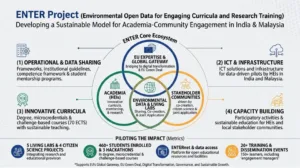
Open data, living labs and responsive curricula function best as mutually reinforcing components of an integrated ecosystem. Pursued in isolation, their broader impact diminishes. Open data provides the empirical foundation, living labs serve as testbeds for collaborative validation and responsive curricula convert field insights into generational skills and community-engaged scholarship.
This framework depends on a polycentric governance model supported by clear institutional mandates. Universities provide methodological rigor, develop analytical tools and curate data. Government agencies provide statutory datasets, set regulatory guidance and channel empirical findings into public policy. Local communities contribute ground-level knowledge, identify immediate priorities and monitor environmental conditions. Industry and civil society partners reinforce the ecosystem through technical infrastructure, funding, public advocacy and the broader deployment of validated solutions.
Operating protocols must govern data ownership, ethical sharing, reuse rights and the formal recognition of community contributions. A polycentric governance structure is especially suited to Malaysian environmental management, where authority is shared across federal, state and local entities. This structure coordinates university research repositories, state agency databases and citizen-science inputs without imposing rigid central control.
Tensions will inevitably arise from conflicting stakeholder priorities, uneven digital literacy, budget limitations and inconsistent data formats. Sustaining the ecosystem requires regular consultative forums and adaptive communication mechanisms to address frictions and revise priorities based on field feedback.
The European Union-funded Environmental Open Data for Engaging Curricula and Research Training (ENTER) initiative illustrates this concept in practice. By coupling living labs, citizen science, open data platforms and responsive curricula across partner institutions in Malaysia and India, ENTER demonstrates how local communities can use environmental data to guide local decision-making.
In Malaysia, this framework is well-suited to managing coastal vulnerability, marine data collection and climate adaptation strategies. The Terengganu Strategic & Integrity Institute (TSIS) serves as an essential policy bridge, translating academic findings into state policy deliberations, notably on coastal erosion and marine habitat monitoring. This institutional link prevents research from gathering dust in academic repositories, placing empirical evidence at the center of state-level planning. The primary achievement of initiatives like ENTER lies not merely in deploying software or publishing syllabi, but in cultivating transparent, durable collaborative institutions that connect scientific enquiry with the public good.
Conclusion
Establishing this collaborative ecosystem begins with concrete, urgent issues that matter directly to local residents such as coastal erosion, municipal solid waste management or river degradation. A phased implementation allows teams to test and refine governance protocols locally before scaling them to more complex jurisdictions.
Data governance and ethical standards must be established during the initial planning phase. Stakeholders need to agree on sampling protocols, community data calibration, accuracy thresholds and privacy protections. Citizen-generated observations must be respected for their contextual detail while meeting scientific standards of validity.
The success of this model should not be judged by superficial metrics, such as counts of uploaded datasets or workshop attendance figures. Meaningful impact is revealed when empirical data shapes policy choices, communities build resilience against environmental hazards, graduates demonstrate versatile analytical skills and durable public trust connects universities, government agencies and the communities they serve.
The ENTER-TSIS Research Team consists of Mr. Eikhwan Ali as Manager and four researchers, Mr. Asyraf Salleh, Ms. Fatin Sophia, Ms. Kyra Aishah and Mr. Wan Muzhaffar. Ass. Prof. Dr. Mohd Hanif Yaacob serves as TSIS Consultant and Advisor.


